
Sumba vs Bali: Why Serious Travellers Are Choosing Sumba
Sumba vs Bali: Why Serious Travellers Are Choosing Sumba
As a travel curator in Sumba for the better part of a decade, the question I hear most often from new callers is, “Is Sumba the new Bali?”
My answer is always the same: I hope not.
This site is written by our editorial desk. For nine years, my work at Sumba Private Tour has been to design journeys that connect people to the real Sumba. It’s a place I love deeply, but it’s not for everyone. And that is perfectly okay. Bali is a beautiful, welcoming island that serves as a wonderful introduction to Indonesia for millions of people. Sumba is a different proposition entirely.
This isn’t an article to convince you that Sumba is definitively better than Bali. It’s an honest briefing to help you decide which island is right for you. The question isn’t just about Sumba vs Bali; it’s about what kind of traveller you are and what you seek from your time in Indonesia.
The Landscape: Savannahs and Solitude vs Terraces and Crowds
The first difference you’ll notice is the very colour of the land. Bali is a deep, volcanic green. Its landscapes are famously lush, carved into intricate rice terraces like those in Tegalalang, and shaded by dense jungle canopies around Ubud. It’s a fertile, tropical environment that feels full and abundant.
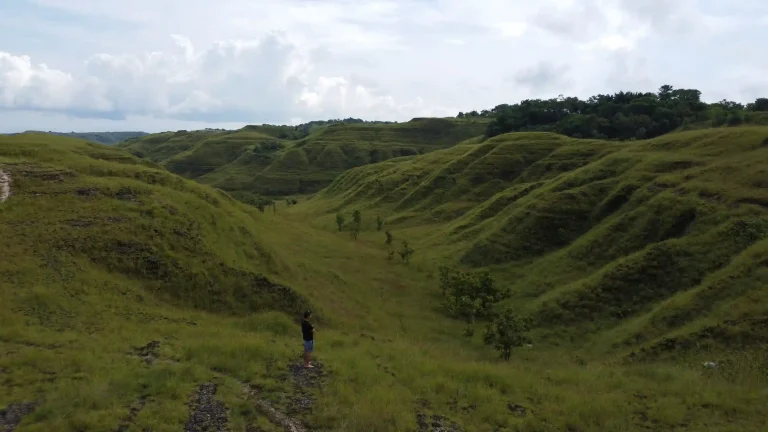
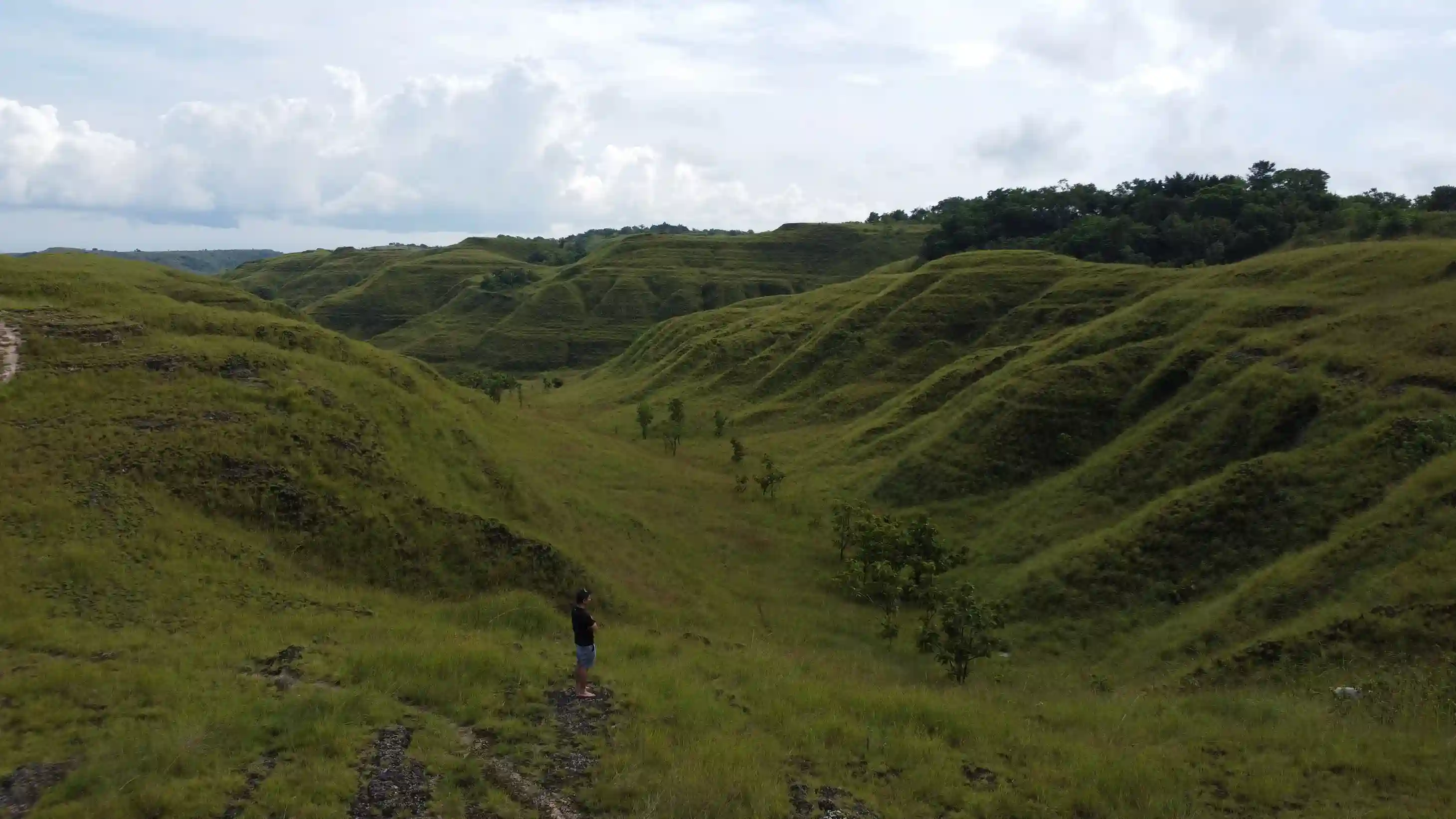
Sumba, by contrast, is golden. It is an island of rolling savannahs, windswept grasslands, and arid limestone hills that feel more like parts of Africa than Southeast Asia. The dry season (April to October) turns the hills a crisp, pale gold, dotted with hardy cashew and teak trees. The coastlines are elemental and raw: long, empty stretches of white sand pounded by the Indian Ocean, framed by dramatic cliffs.
This difference in landscape creates a profound difference in atmosphere. In Bali’s popular areas, the feeling is one of energetic, constant activity. There is always something to see, a cafe to visit, another scooter whizzing by. In Sumba, the overwhelming feeling is one of space. Driving through the countryside, you can go for long stretches seeing only wild horses, small villages of distinctive high-peaked homes, and the vast, open sky. The silence is broken by the wind, not by traffic.
The Culture: An Observed Faith vs A Lived Reality
This is perhaps the most critical distinction for those wondering, is Sumba better than Bali for a cultural experience. Both islands have powerful, deeply held spiritual beliefs.
In Bali, Balinese Hinduism is visible and accessible. The daily canang sari offerings, the ornate temple architecture, and the frequent public ceremonies are a beautiful part of the island’s fabric. As a visitor, you can easily observe these practices, watch a Kecak fire dance, or visit a major temple like Uluwatu or Tanah Lot. It is a culture that has learned to present itself to the outside world.
In Sumba, the ancient Marapu belief system is not a presentation; it is the absolute core of existence. It is a complex animist faith centred on ancestor worship, intricate rituals, and a deep connection to the natural and spiritual worlds. You don’t observe Marapu culture from a distance—when you visit a traditional village, you are stepping directly into its sphere.
This requires a different approach. You cannot simply wander into a traditional village like Ratenggaro or Praiijing. It is essential to be accompanied by a guide who understands the adat (customary law). We bring gifts of betel nut for the village elders, ask permission to enter, and explain who you are and why you have come. You will see megalithic tombs, some centuries old, standing among the living, a constant reminder of the presence of ancestors. The high-peaked clan houses (uma mbatangu) are not just buildings; they are cosmological maps of the Marapu universe. This is a living, breathing culture, and visiting requires participation, not just observation. It is a privilege, and one we take very seriously.
Logistics and Comfort: The Honest Briefing
This is where we must be very direct about the Sumba or Bali which to visit dilemma. Your choice will heavily depend on your tolerance for logistical challenges and your definition of comfort.
Getting Around
- Bali: Effortless. You can rent a scooter for a few dollars, use ride-hailing apps like Gojek or Grab, hire a private car with a driver for the day, or take a taxi. The road network is extensive and, for the most part, paved and in good condition.
- Sumba: Requires planning. There is no public transport to speak of and no ride-hailing apps. You must hire a private car with a local driver. For many of the more remote villages, beaches, and waterfalls, a 4WD vehicle is not a luxury—it is a necessity, especially during the wet season (roughly November to March) when dirt roads can become impassable tracks of mud. A 100-kilometre journey in Sumba can take three to four hours. You cannot rely on Google Maps for timing.
Accommodation & Food
- Bali: Limitless choice. From five-dollar-a-night hostels to some of the world’s most exclusive luxury resorts, Bali has it all. The food scene is equally diverse, with world-class fine dining, vegan cafes, brunch spots, and thousands of local warungs.
- Sumba: Limited, but growing. Sumba is known for NIHI Sumba, one of the world’s top resorts, but beyond that and a few other excellent high-end lodges (like Lelewatu and The Sanubari), the options are simpler. There are some comfortable, well-run local hotels and eco-lodges, but they are fewer and farther between. In remote areas, you might stay in a clean but basic homestay. Restaurants are concentrated in the main towns of Waingapu and Tambolaka. On the road, lunch is often a simple, delicious meal of grilled fish or chicken with rice at a small local eatery your driver knows. You come to Sumba for the experience, not for the acai bowls.
Health and Pace
- Bali: Relatively straightforward. Medical facilities are widely available in the south. The main health concerns are the usual travel ailments.
- Sumba: Requires preparation. Malaria is present in Sumba. It is not a certainty you will get it, but the risk exists, particularly in the wet season. We strongly advise all our guests to consult their doctor about anti-malarial prophylaxis before travelling. Furthermore, Sumba demands a slower pace. The distances and road conditions mean you cannot rush. A weekend trip is not feasible. We recommend a minimum of five days to explore just one part of the island (West or East) and 10-14 days to experience both meaningfully.
The Pasola Problem: An Illustration of Sumba’s Rhythm
A perfect example of the Sumba Island vs Bali difference is the Pasola festival. This is a series of ancient, spectacular, and sometimes violent ritual battles on horseback. Many travellers want to see it.
In Bali, a festival date is on the calendar a year in advance. In Sumba, the exact date of Pasola is a secret held by the Rato (Marapu priests). It is determined only a few weeks beforehand, when the priests venture to the coast to observe the arrival of the nyale, a type of colourful sea worm. The reading of the worms determines the timing and predicts the year’s harvest. The festival happens on Sumba’s schedule, not ours. This uncertainty is the essence of the island. You must surrender to its rhythm.
So, Who Should Choose Sumba?
Sumba is for the traveller who has perhaps already seen Bali, or is looking for a different kind of Indonesia. It is for you if:
- You are an avid photographer seeking elemental landscapes and authentic human connection.
- You are a cultural traveller who is genuinely curious and willing to adapt to local customs.
- You find deep satisfaction in solitude and wide-open spaces.
- You understand that long drives on bumpy roads are part of the adventure, not an inconvenience.
- You are tired of crowded destinations and want to see a place where tourism is not the main event.
And Who Might Prefer Bali?
Bali remains the better choice if:
- This is your first trip to Indonesia and you want a smoother, more convenient introduction.
- You are travelling on a very short timeline (less than a week).
- Your priority is comfort, a wide variety of food, shopping, and easy logistics.
- You are travelling with young children who need constant stimulation and easy options.
- You are seeking a vibrant social scene, nightlife, or wellness retreats.
Sumba is not an “upgrade” from Bali; it is a parallel path. It asks more of you as a traveller—more patience, more flexibility, more respect, and more preparation. In return, it offers a powerful connection to a land and a culture that remain profoundly themselves. It is a journey that stays with you long after you have washed the dust from your shoes.
If that sounds like the journey you are seeking, then perhaps Sumba is calling to you. And we would be honoured to help you answer.
Keep Reading
Uncategorized
Is Sumba Family-Friendly? Travelling with Children to Sumba Island
Considering a Sumba with family trip? Our editorial desk offers candid advice on safety, malaria, roads, and activities for a…
Uncategorized
Photography in Sumba: Tips, Ethics & the Best Locations to Shoot
A practical Sumba photography guide covering ethical practices, essential gear, and the best locations like Walakiri, Weekuri, Ratenggaro, and Pasola.
Uncategorized
Konda Lake East Sumba: Birdwatching at Sumba’s Hidden Waterway
Discover Konda Lake East Sumba, a tranquil tidal waterway near Waingapu, ideal for Konda Lake birdwatching and observing Sumba's unique…